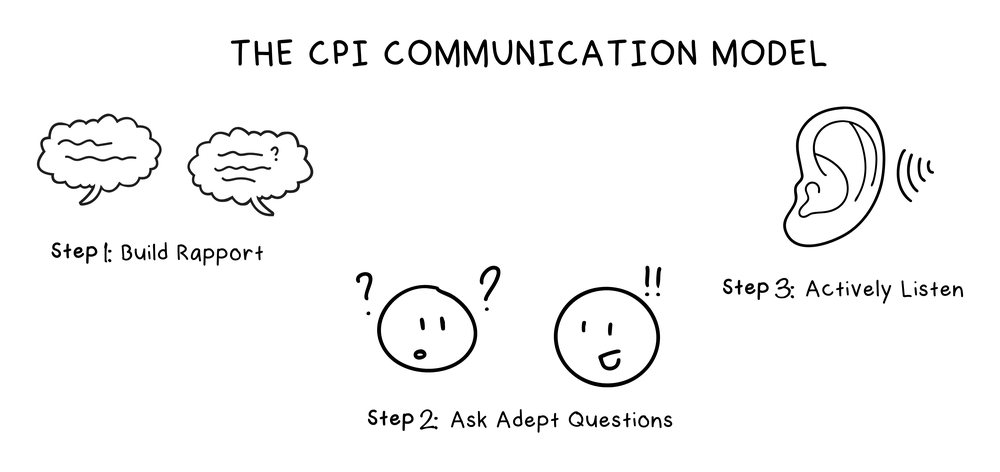
This is not about you. It is about them. As you learn who is across the table, run every answer through the model.

Get Teach to Sell Give the instruction once, at normal speed. Then ask them to play it back.
CPI Community · Free tools
Six seats. 49 questions. Each one comes with the exact words to say and the line between a green and a red.
You have hired well and you have hired badly. The interview felt about the same both times. That is the problem. A rehearsed answer sounds like evidence, right up until the person is in the seat.
CPI is Consistent and Predictable Income. Every real estate agent wants CPI. This is the interview the CPI Community runs, written out so you can run it too. Free, no login, nothing to buy.
Every question below is built to surface evidence instead of a story. Some of them create the thing they are testing rather than asking about it. You will find those marked as weighted heaviest.
Skip the reading and run the interview live ↓
This seat protects the client relationship when you are not in the room. The risk is not a missed detail. It is a clear instruction heard inaccurately and then acted on with confidence.
Grade each answer Green or Red before you move on. If you could not test it, mark it untested rather than guessing.
What you do. Give the instruction once, at normal speed. Then ask them to play it back.
Say this, word for wordThe photographer is scheduled Friday at 3:30 at 123 Main Street. The seller asked that nobody arrive before 3:15, and does not want the garage photographed. Once the appointment is confirmed, text the seller and email the agent. Please repeat the important details back to me and tell me exactly what you would do.
What you are really testing. This is the seat's whole risk. The failure is NOT forgetting the address. It is hearing a clear instruction and interpreting it INACCURATELY, then proceeding confidently. Say it once. Do not repeat it. Do not help them.
Green. Plays back every constraint accurately: the 3:15 floor, the garage exclusion, the confirm-THEN-notify order, both notify channels. Calm. Asks to confirm anything they are unsure of.
Red. Drops or softens a constraint. Reorders the sequence. Says “got it” without playing it back. Fills a gap with an assumption instead of asking. Any confident-but-wrong detail is a hard RED.
What you do. Add this, and say nothing else. Then wait.
Say this, word for wordOne more thing. The seller mentioned they may not be home. Go ahead and handle it.
What you are really testing. There is no right answer here, only a right INSTINCT. “Handle it” is deliberately ambiguous and the seller is not home, which collides with the 3:15 rule and access. The person who burns you fills the gap themselves and sounds sure. The person who saves you ASKS.
Green. Asks a clarifying question before acting. Names the conflict (no seller, access, the 3:15 window). Confirms rather than assumes. Would rather ask than guess.
Red. Invents a plan and states it confidently. Never asks. Says they would “figure it out.” Assumes access, or assumes the 3:15 rule no longer applies.
What you do. Tell me about a time a client outcome went wrong on your watch. Walk me through exactly what you did.
Follow up. If they deflect to generic process instead of naming a real failure they personally owned:
I hear the process. But I need a specific transaction where something broke because of something YOU did. Walk me through that one.
Then be silent. Do not offer an easier version. If they still cannot produce one, that IS your answer.
Green. Names their own decision and their own fix. Uses “I.” No blame on the market, the tools, a prior employer, or a teammate.
Red. Blames circumstances or other people. Deflects to process. Cannot produce a specific instance. No “I” in the failure.
What you do. Quick one. In fifteen seconds, tell me why you are a strong fit for this seat. Go.
Say this, word for wordThat was fine, but it ran long and had no specific example. Do it again, shorter, with one concrete example.
What you are really testing. Deliver the feedback above word for word, then watch them redo it. This does not ask ABOUT coachability, it creates it. Your job here is to read HOW they take the coaching, not the content of what they say. Do they get defensive, or do they get curious? Do they actually follow the direction you gave? Nothing has to be remembered from earlier in the call. Watch the face before the mouth.
Green. Takes it without defending. Actually shortens it. Adds the concrete example. No wounded tone.
Red. Defends the original. Explains why they said it that way. Barely changes it. Visible flinch or sulk.
What you do. Four things land at the same moment. Tell me the order you handle them, and why.
Say this, word for wordA closing document is due in one hour. A buyer's inspection starts in 30 minutes but access is not confirmed. A seller wants showing feedback. A photographer needs a confirmation for next week.
What you are really testing. Do not hint. The reasoning matters more than the order. Access-in-30 is the real emergency because it fails hardest and soonest, but a defensible case for the closing doc is fine. What you are grading is whether they REASON or just react.
Green. Ranks by consequence and deadline, and says why. Handles the 30-minute access risk fast. Batches or defers the low-stakes items without dropping them.
Red. Handles in the order given. Goes newest-first or easiest-first. No reasoning. Drops an item entirely. Freezes.
What you do. Say this as the client, with real irritation, then: “Respond to me as though I am the client.”
Say this, word for wordI have called twice and nobody has gotten back to me. I am starting to regret hiring your company.
What you are really testing. This covers the leader's gap. You are fast and blunt; this seat has to be the warmth. Do NOT rescue them if they flounder. Push once more if they go generic.
Green. Acknowledges the feeling before explaining anything. Owns it without grovelling. Gives a specific next step and a time. Voice stays warm and steady.
Red. Defends or explains first. Blames a system or a colleague. Goes robotic or scripted. Over-apologizes without a fix. Matches the client's heat.
What you do. What does excellent client care look like when there is no good news and no final answer to give?
What you are really testing. This is the actual daily job of this seat. Most of the role is delivering non-answers well. If they only know how to communicate when they have news, they cannot do this job.
Green. Communicates anyway, on schedule. Says what is known, what is not, what happens next, and when they will check back. Treats the update itself as the deliverable.
Red. Waits until they have something. Goes quiet. Thinks no news means nothing to say. Over-promises to fill the silence.
What you do. A client asks you a question and you do not know the answer. What do you say and do?
What you are really testing. Directly tied to the interpretation failure. The dangerous person guesses, sounds certain, and you find out later.
Green. Says plainly they will find out. Commits to a specific time to come back. Knows exactly who to ask. Never guesses in front of the client.
Red. Guesses. Gives a directional answer to seem competent. Vague on when they will follow up. Says they would “look it up” with no mechanism.
What you do. How do you prefer to work with a fast-moving, big-picture leader who is blunt and skips the details?
What you are really testing. Ask it, then GO SILENT. Do not describe yourself first, or you hand them the answer key. This tests whether they can survive you specifically.
Green. Fills the gap comfortably. Brings the detail, slows what needs slowing, asks clarifying questions without taking bluntness personally. Sees it as division of labor.
Red. Wants to match that energy. Competes for the visionary role. Needs the leader to supply the detail. Signals they would be hurt by bluntness.
What you do. Much of this role is repeated calls, updates, reminders, and admin. Tell me about a time you did work that was repetitive and unexciting but mattered. How did you stay consistent?
What you are really testing. This seat IS repetition. Charisma will not carry it. A candidate who lights up only for novelty will drift in month three.
Green. Names a real stretch of unglamorous work and a concrete mechanism (checklist, cadence, tracker). Steady is a point of pride, not a complaint.
Red. Cannot name one. Reframes to something exciting instead. Talks about motivation rather than mechanism. Hints that routine bores them.

A cold caller lives on the third no. You are not testing whether they can talk. You are testing what happens to them after the call goes badly.
Grade each answer Green or Red before you move on. If you could not test it, mark it untested rather than guessing.
What you do. Don't describe your calling. Do it.
Say this, word for wordI'm a FSBO who just picked up. Call me and get the appointment. Go.
What you are really testing. Play mildly hostile. Do NOT rescue them. Do not accept a description of what they would say. Make them run it live.
Green. Runs the open. Natural voice. Handles one objection without folding. Actually asks for the appointment.
Red. Describes instead of performs. Voice drops or rushes. Folds at the first objection. Never asks for the appointment.
What you do. How do you want to be paid: a smaller base with a big bonus for what you close, or a steady, predictable paycheck?
What you are really testing. A cold hunter wants the bonus and bets on themselves. Wanting the steady paycheck is not a red flag, it just means they fit the Warm Caller seat, not this one.
Green. Wants the bonus. Bets on themselves. A hunter. This seat fits.
Red. Wants the steady paycheck. Not a cold hunter. Redirecting to the Warm Caller seat.
What you do. What is the most appointments you have set in a single day, and what did that day look like hour by hour?
What you are really testing. The bar for this seat is two appointments daily. This tests whether they have LIVED that number or only want it. A real day can be reconstructed. An imagined one cannot.
Green. A real number and a real day they can walk through hour by hour. Specific.
Red. Vague. Aspirational. 'It depends on the list.' Cannot reconstruct an actual day.
What you do. Walk me through your worst stretch on the phones. What did you do the next day?
Green. Kept dialing. Names a concrete number. Treats rejection as volume math, not a verdict on them.
Red. Slowed down. Avoided the phone. Blamed the list or the script. Talks about motivation instead of activity.
What you do. Role-play. I am going to hang up on you.
Say this, word for wordNot interested. [click] What happens in your next sixty seconds?
Green. Next number, immediately. No processing time needed.
Red. Needs a reset. Analyzes what went wrong. Takes it personally.
What you do. Tell me about a stretch of work nobody would have noticed if you had skipped it. Did you do it?
Green. Did it anyway. No audience needed. Names something specific and unglamorous.
Red. Cannot name one. Reframes to something visible or praised.
What you do. Tell me about a month you missed your number. What caused it?
Green. Owns their own activity gap. Uses 'I'.
Red. Blames the list, the script, the market, the leads.
Warm calling is the long game. The database does not reward charm. It rewards the person who still calls in week nine.
Grade each answer Green or Red before you move on. If you could not test it, mark it untested rather than guessing.
What you do. Do it live, not in theory.
Say this, word for wordYou called me six months ago, I said not yet, and you never called back. Re-engage me right now. Go.
What you are really testing. Play a lead who has gone cold and is mildly annoyed to hear from them. Do not help them.
Green. Warm, unrushed reopen. References the history naturally. Rebuilds rapport before asking for anything. Lands a soft next step.
Red. Cold or scripted. Jumps straight to a pitch. Cannot rebuild rapport. Pushes a close that is not earned.
What you do. How do you want to be paid: a smaller base with a big bonus for what you close, or a steady, predictable paycheck?
What you are really testing. A warm caller is fine with steady pay on warmer leads. If they light up at the big-bonus option and are hungry, they may be a Cold Caller hunter.
Green. Comfortable with steady pay on warmer leads. This seat fits.
Red. Lights up at the big bonus and is hungry. May be a Cold hunter. Redirecting to the Cold Caller seat.
What you do. What is the most appointments you have set in a single day? Walk me through that day.
What you are really testing. The bar is two appointments daily. A real day can be reconstructed hour by hour. An imagined one cannot.
Green. A real number and a real day, specific and reconstructable.
Red. Vague or aspirational. Cannot walk through an actual day.
What you do. Tell me about a lead you converted that took many months. How did you track it and keep going?
Green. Real cadence, real tracking mechanism, real touch count over months. Persistent without being pushy.
Red. Vague on timeline. No tracking method. Gave up early. Only works leads that are already ready.
What you do. Right now, today, how do you know who you owe a callback to?
What you are really testing. Present tense on purpose. This is not about their philosophy of follow-up. It is about whether a mechanism exists right now.
Green. Names a specific mechanism they can describe.
Red. Memory. 'I just remember.' No system.
What you do. Tell me about work you did that nobody would have noticed if you had skipped it.
Green. Did it anyway. Names something specific and unglamorous.
Red. Cannot name one. Reframes to something visible.
What you do. Tell me about a lead you lost that you should not have.
Green. Owns the gap in their own follow-up.
Red. Bad timing. The lead was not real. Not my fault.
A leader you hire is a leader who builds. Look for someone who has already built something without being asked, and who wants to teach.
Grade each answer Green or Red before you move on. If you could not test it, mark it untested rather than guessing.
What you do. Tell me about a team or group you built or grew from a small start. How many people did you personally bring in?
What you are really testing. THE gate for this seat. You are testing whether they have actually built, not just belonged. A real builder can name the people they brought in and what they did to attract them.
Green. Names a real group they grew and specific people they brought in themselves. Concrete actions.
Red. Has only ever belonged to someone else's team. Vague. No one they personally attracted.
What you do. What would you bring to a partnership like this that we could not just hire?
What you are really testing. You want a partner who brings something, not someone waiting to be carried. Confidence and contribution, not worship.
Green. Names real strengths, a network, a work ethic, a skill they own. Talks like a partner.
Red. Wants to be rescued or carried. Focuses on what they will get. Nothing they bring stands out.
What you do. This seat is two recruiting appointments a day, every day. What is the most you have ever done consistently, and for how long?
Green. Has lived a real recruiting cadence and can name the number and the duration.
Red. Never has. Did it briefly. Treats the number as negotiable.
What you do. Tell me about someone you personally attracted into a business. What did you actually do?
What you are really testing. Most people answer this generally. If they stay vague, push once: who specifically, and what did you actually say or do? A real name and real actions, or it does not count as proof.
Green. A specific person. Specific actions. They did the work themselves.
Red. Never has. It was handed to them. Vague or secondhand.
What you do. You would host one opportunity class a week. Teach me right now, two minutes, why someone should join eXp.
What you are really testing. Teaching is the method. This is a live test, not a question about their philosophy. Do not let them off with a description of what they would cover.
Green. Teaches, does not pitch. Clear and structured. Makes you want in. Handles it cold.
Red. Recites features. Sells instead of teaches. Cannot do it without prep.
What you do. Who follows you today, and why?
Green. Real names. Real reasons. Earned influence.
Red. Title-based authority. Or nobody.
What you do. You might be building a new organization here, or stepping in to lead one that already exists. Either way it will not run itself. What do you feel about that?
What you are really testing. Be honest about whichever is true for your seat. Someone who needs a finished machine handed to them will struggle. Someone who wants to build or strengthen one will be energized.
Green. Energized either way. Asks what they would own and what needs building. Sees the opportunity.
Red. Expects a finished machine. Deflates. Immediately asks what leads or team they get handed.
What you do. Tell me about a good person who left your team. Looking back, what would you have done differently?
Green. Owns their part. Names their own decision or gap.
Red. Blames the person who left. They were not committed. No self-reflection.
This one does not sort into hired and not hired. It sorts into three: the agent who belongs on your team, the agent who needs the method first, and the agent who is neither.
Grade each answer Team Fit, CPI Community Fit, or Neither before you move on.
What you do. Take me to a year the business did not go the way you wanted. What did you change coming out of it?
What you are really testing. This gate OVERRIDES production entirely. A big producer who points at the market, the brokerage, the leads, or rates does not come onto the team, no matter the number. The change they name tells you whether it lives in them or in their excuses.
Team Fit. Owns it. Names what they did or did not do, and what they changed. The year is theirs and so is the fix.
Neither. Blames the market, the brokerage, the leads, or interest rates. The year happened TO them and nothing changed.
What you do. Why this team specifically?
What you are really testing. Ask, then go silent. Do NOT sell the team. Worship is a RED that no production number buys back.
Team Fit. Wants a partnership, not a savior. Respect without worship. Confident, not dependent.
Neither. Worships the leader, the record, or the book. Wants to be carried.
What you do. The team lead-generates together on Zoom, daily, on a schedule. That is how the work happens here. What do you feel about that?
What you are really testing. HARD GATE. The Zoom room is the mechanism that lets this org run without managing people. An agent who will not join it is not joining the company. A RED here routes to CPI, which is NOT a rejection: they get the method, get results, build belief, and come back through the chain properly.
Team Fit. In. Gets why. No negotiation.
CPI Community Fit. Negotiates. Wants to work alone. Treats it as micromanagement. Route to CPI Community at eXp.
What you do. In a normal week right now, how much new business are you putting on your own calendar, and where is it coming from?
What you are really testing. The private yardstick is roughly three first-time appointments a week from a repeatable source. Do NOT say the bar out loud; let them describe their week. Strong and self-sourced points to Team Fit. Thin because they have never had a method points to CPI, where they get the method first.
Team Fit. Knows the number and the source. Producing at a real clip from something repeatable. The gap is leverage, and leverage is what the team hands them.
CPI Community Fit. The number is thin, and it is a method gap rather than a leverage gap. They have never had a consistent way to generate. Route to CPI.
What you do. What is actually stopping you from doubling?
What you are really testing. THE segmentation question. Systems/support/leverage = a no-systems problem, which is exactly what a team solves. Skill/consistency/mindset = they need the METHOD first, which is CPI.
Team Fit. Names systems, support, leverage. They can already sell. The problem is everything else.
CPI Community Fit. Names skill, consistency, or mindset. They need the method before the machine.
What you do. Tell me about a deal you are proud of. What did you actually do that made it come together?
What you are really testing. Pride opens them up; the mechanics tell the truth. You want a process they own and could run again. If it closed itself or it was luck, they need the method before the machine.
Team Fit. Real, repeatable mechanics. They drove it and can describe how. The team can hand them leverage on top of that.
CPI Community Fit. Vague. The lead closed itself, or it was luck. No process they could repeat. Route to CPI.
What you do. Describe how you would want a team leader to work with you.
Team Fit. Wants the machine and the runway. Self-directed.
CPI Community Fit. Wants coaching, structure, someone standing over them. That is CPI Community, not the team.
What you do. What is a part of this work you take pride in that your clients never actually see?
What you are really testing. Willingness to do the unseen work is a character read and a hard stop if it is absent, not a CPI route. You are listening for someone who does the quiet work when no one is watching.
Team Fit. Names something specific and unglamorous they do anyway, because it serves the client or the craft.
Neither. Cannot name one. The unseen work is not there.
What you do. Quick one. In fifteen seconds, tell me why you are a strong fit for this team. Go.
Say this, word for wordThat was fine, but it ran long and had no specific example. Do it again, shorter, with one concrete example.
What you are really testing. Deliver the feedback above word for word, then watch them redo it. Your job here is to read HOW they take the coaching, not the content of what they say. Do they get defensive, or do they get curious? Do they actually follow the direction you gave? Nothing has to be remembered from earlier in the call. Watch the face before the mouth.
Team Fit. Takes it without defending. Actually shortens it. Actually adds the specific. No wounded tone.
Neither. Defends the original. Explains why they said it that way. Repeats it nearly unchanged. Visible flinch or sulk.
Marketing is graded on business created, not on work produced. The question underneath every question here is whether they know the difference.
Grade each answer Green or Red before you move on. If you could not test it, mark it untested rather than guessing.
What you do. Tell me about a campaign you were proud of. Walk me through it, and tell me how you knew it worked.
What you are really testing. THE gate for this seat. A marketer who measures in reach, impressions, likes, or followers will spend your money making you feel famous instead of booked. Listen for leads, appointments, cost per lead, or closed business. Do not accept engagement as a result.
Green. Names leads, appointments, pipeline, cost per lead, or revenue. Knew the number before and after. Ties the creative to a business outcome.
Red. Reaches for impressions, reach, likes, follower growth, or engagement. Cannot say what it cost or what it produced. Proud of the art, not the result.
What you do. Here is a real one. Our home valuation page gets traffic and almost no leads. You have this afternoon. Tell me exactly what you would change and in which tool you would change it.
What you are really testing. Live test, not philosophy. This seat has to BUILD, not delegate. Someone who answers in strategy words like optimize the funnel or improve messaging, with no concrete change and no tool they can open today, is a briefer, not a builder. In a small team a briefer is a cost.
Green. Concrete changes: the headline, the form length, the offer, the follow-up, the tracking. Names the actual tool and could start today. Asks to see the analytics first.
Red. Stays in strategy language. Needs to hire someone to execute. Cannot name a specific change or a tool. Would put together a plan and get back to you.
What you do. A month you ran three things at once and leads went up. How would you figure out which one actually did it?
What you are really testing. The honesty gate. A marketer who claims the whole lift, or who has no way to isolate a source, will keep spending on what is not working. Same failure as an ISA counting dials instead of held conversations. Listen for real measurement, not a tidy story.
Green. Isolates it: tracking links, source fields, hold-outs, timing, asking leads how they found you. Comfortable saying they are not sure yet and here is how they would find out.
Red. Claims all the lift. No way to separate the channels. Tells a clean story with no measurement under it.
What you do. Give me the first line of an ad to a solo agent who is drowning. Out loud is fine.
What you are really testing. Live copy test against the doctrine: the reader is the hero, pain then action then result, no talking about us. A line that opens on the brand, the book, or the word we, fails. Length is not the point. Whose story it is, is the point.
Green. Opens on the agent's pain or the agent's want. The reader is the hero. Speaks to them, not about us.
Red. Opens on the company, the founder, the book, or a clever line about the brand. Makes the business the hero.
What you do. If I handed you the budget tomorrow, what is the first thing you would spend it on, and why that first?
What you are really testing. Watch for shiny-channel chasing. A strong hire fixes the offer and the funnel math before pouring money into a new platform. Jumping straight to a trendy channel, with no question about the offer or the follow-up, is buying activity, not results.
Green. Asks about the offer, the conversion rate, and the follow-up before naming a channel. Spends where the math already works, then scales.
Red. Names a trendy channel immediately. No questions about the offer or the funnel. Confuses being busy on a platform with producing leads.
What you do. How would your message change if you were writing to a nervous home seller versus an agent you are trying to recruit?
What you are really testing. Generic marketers write one voice for everyone. Listen for real understanding of both the nervous seller and the skeptical recruit, not platitudes.
Green. Draws a real distinction. Understands the fear of the seller and the objection of the recruit. Adjusts the proof and the tone, not just the words.
Red. One message for everyone. Platitudes. Cannot say how a seller and a recruit differ beyond the surface.
What you do. The last thing you tried that did not work. How did you know, and what did you do next?
What you are really testing. Marketing without measurement is decoration. You want someone who sets a number, reads it honestly, kills what fails, and iterates. Someone who cannot name a failure either has not shipped much or does not measure.
Green. Names a real miss, the metric that revealed it, and the next iteration. Treats a dead test as information.
Red. Cannot name a failure. Everything did great. No metric, no next step. Defends the work instead of the result.
What you do. You ship something you love. The data says it is not converting and I want it changed. What happens?
What you are really testing. The counterweight for a creative seat. Talent that cannot take brand feedback will quietly protect its own taste over the pipeline. You want someone who serves the number, not their portfolio.
Green. Changes it without a fight. Curious about the data. Their taste serves the result, not the reverse.
Red. Defends the work. Argues taste over data. Needs to be right more than they need it to convert.
Hiring is the same skill as selling. You are not there to convince anyone. You are there to ask Adept Questions, listen to what is actually said, and let the evidence decide.
CPI is Consistent and Predictable Income. Every real estate agent wants CPI. In the Room, agents practise these conversations live, twice a month, for free.
This is not about you. It is about them. As you learn who is across the table, run every answer through the model.

Get Teach to Sell Give the instruction once, at normal speed. Then ask them to play it back.